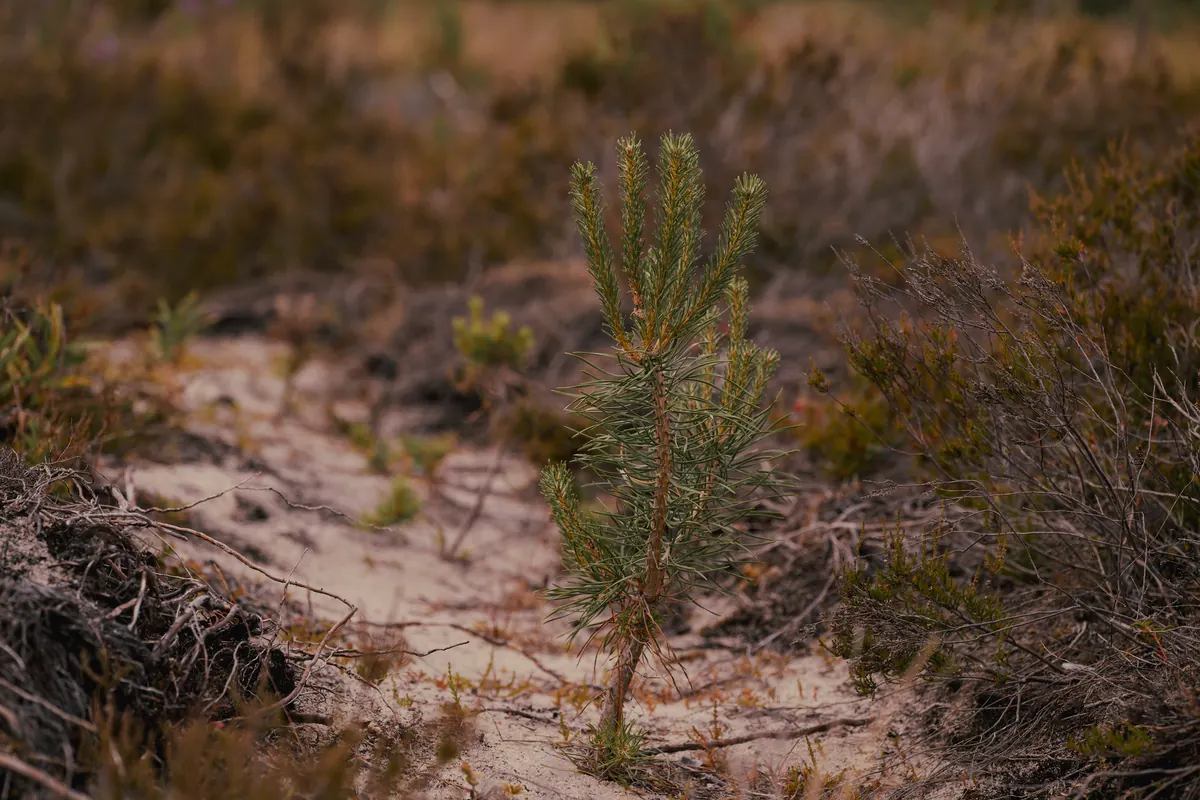
Pines are tempting. They bring evergreen structure, a resin scent on warm afternoons and a silhouette that looks settled the day it is planted. In a small garden, though, the margin for error is thin. A tree that reads as a graceful backdrop in an acre can swallow a courtyard in ten years, and the mistakes that cause it are usually made in the first hour — in a garden centre, with a trolley and no tape measure.
Buying a Species That Will Outgrow the Space
A Scots pine (Pinus sylvestris) in a two-litre pot looks like something you could keep on a balcony. Twenty years on it is a tree of 15 metres or more, with a trunk you cannot put your arms around. Austrian pine (Pinus nigra), Monterey pine (Pinus radiata), Himalayan blue pine (Pinus wallichiana) and eastern white pine (Pinus strobus) are all magnificent, and all far too large for a typical town plot.
Good small-garden pines do exist. Pinus mugo cultivars such as 'Mops' stay compact for decades; Pinus pumila is a low, spreading shrub; Japanese white pine (Pinus parviflora) is slow and elegant; Pinus heldreichii 'Satellit' makes a narrow column that suits a tight corner. None is small in the way a lavender is, but they are manageable.
Read the eventual height and spread on the label, not the size of the pot. If only a height is given, look the species up properly before you buy. Ten minutes of research beats a chainsaw later.
Trusting the Word "Dwarf"
"Dwarf" means smaller than the species, not small. A dwarf cultivar of a pine that reaches 25 metres may still reach five or six, given time. It is a relative term, and it gets stretched.
There is a particular trap with seedling mountain pines. Pinus mugo raised from seed varies enormously: some plants stay as tight cushions, others sprawl three metres wide. If you want a predictable shape, buy a named cultivar, ideally grafted or grown from cuttings, and ask how much it grows in a year. Growth rate matters as much as final size in a small garden — some dwarf pines add two centimetres a year, others thirty.
Planting Into Soil That Stays Wet
Pines are plants of well-drained ground, and winter wet is far harder on them than cold. Heavy clay that sits soggy from November to March is the worst place you can put one. Before planting, check the hole after heavy rain, look for a compacted layer a spade's depth down, and notice whether the lawn squelches underfoot.
If drainage is poor, plant on a mound or in a raised bed, working grit into the soil over a wide area. Do not dig an elaborate pit of rich compost in heavy clay — it fills with water like a sump. A few species, notably Pinus nigra and Pinus mugo, cope with heavier and even alkaline soils; Pinus strobus wants acid, freely draining ground.
- Set the root collar level with, or slightly above, the surrounding soil.
- Improve a broad area rather than a narrow planting hole.
- Mulch with bark or gravel, kept clear of the trunk.
- Water well for the first two summers, then ease off; pines dislike constant irrigation.
- In containers, use a gritty mix and never leave the pot standing in water.
Getting the Light and Exposure Wrong
Almost all pines want full sun. In shade they grow thin and leggy, losing the density that makes them worth the space. A spot that looks bright in June can be gloomy by December once a fence or building casts its shadow, so check the sun's path across the year, not just on the day you plant.
Exposure matters too. Young pines benefit from shelter while they establish, since cold, drying winds scorch needles. Coastal gardens suit Pinus nigra and, in mild areas, Pinus radiata; exposed inland and upland sites are better with Pinus sylvestris, Pinus mugo or Pinus cembra.
Ignoring the Space Around and Below
Pines spread. A canopy that fits the gap now will not fit it in fifteen years, and a tree leaning over a neighbour's conservatory is a problem you cannot prune away, because pines do not regrow from old wood. Plant for the mature spread and keep a generous distance from boundaries, patios, paths and drains. If a large pine is going anywhere near a building or a drainage run, take advice from a qualified arborist before you dig.
Below ground, pines are competitive. Their roots travel widely, and the soil beneath them dries out and turns acidic as needles fall. Underplant with gravel, spring bulbs or tough ground cover rather than treasured perennials.
Forgetting How Pines Grow
This is the mistake that turns a planting into a long argument. A pine will not shoot again from bare, leafless wood. Cut a branch back into the old growth and you have a permanent stump. If you need a plant that takes hard pruning, choose yew or holly, not a pine.
The right approach is gentle and annual. In late spring, when the new shoots — the "candles" — are extending but the needles have not yet hardened, pinch or cut them back by about half. That keeps a small pine dense and slows it without shock. Start the year you plant it; a pine trained from youth stays manageable, while one left alone for a decade cannot be brought back into bounds.
A pine does not forgive a hard cut. Choose the right plant, then shape it a little, every year.
Before You Buy: A Short Checklist
- Eventual height and spread, plus annual growth rate.
- Full species name, not just "dwarf pine".
- Whether the plant is grafted, cutting-grown or seed-raised.
- Drainage and soil pH in the intended spot.
- Sun for most of the day, and shelter while young.
- Distances to boundaries, buildings, paths and drains.
- Who will do the spring candle pruning, every year.
Get those answers and a pine becomes one of the easiest trees in the garden: evergreen, wind-hardy, needing little beyond a sunny spot and free-draining soil. Get them wrong and you will spend a decade managing a plant that keeps winning. The difference is usually a tape measure, a label read properly, and an honest look at the soil.
Photo: Lauri Poldre / Pexels