Few things take the shine off a well-grown pine crop faster than a canopy that browns from the inside out. Red band needle blight, caused by fungi in the genus Dothistroma, does exactly that. It mottles the needles, strips out the older year classes and leaves trees looking tired long before their time. In parts of eastern England it has changed what foresters are willing to plant on sandy heathland sites. The encouraging part is that it can be managed: with sensible species choice, better spacing and a little hygiene, a pine stand is still worth growing.
What red band needle blight looks like
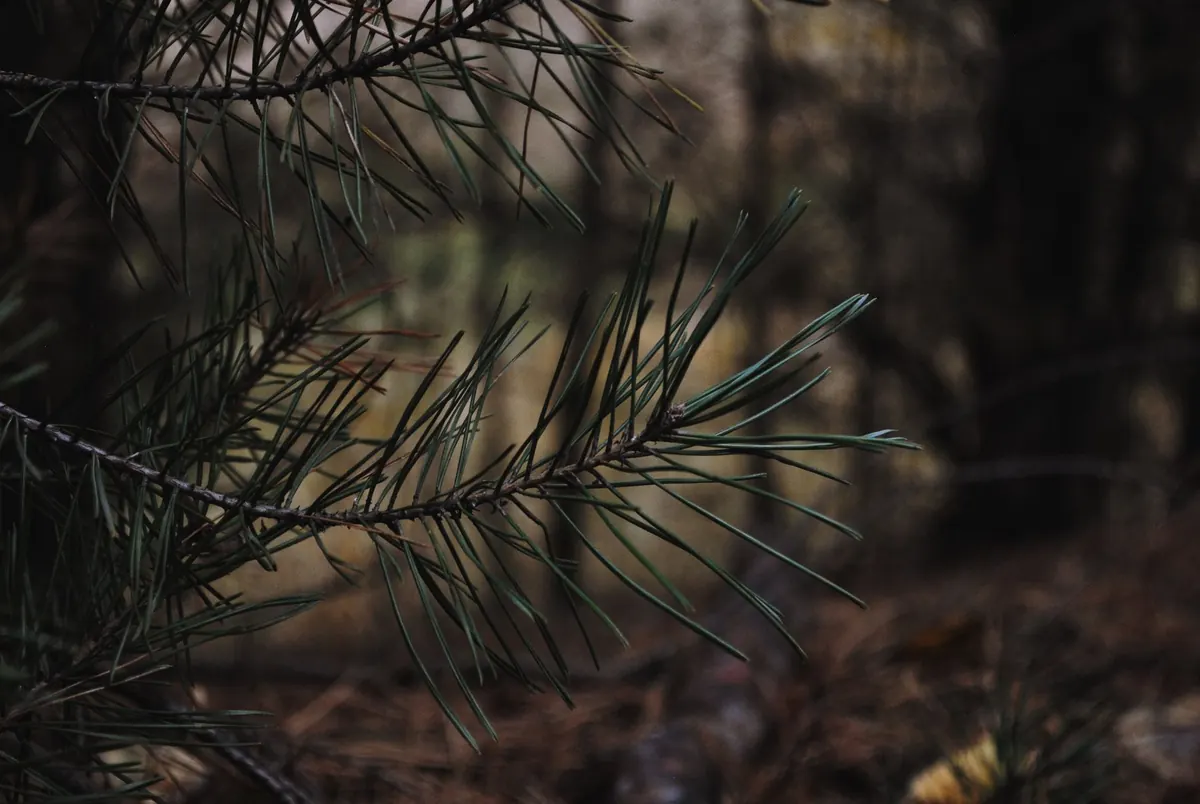
Start by looking at the lower and inner crown, where the older needles sit. Early infection shows as yellow or tan flecks that stretch sideways across the needle. Within a few weeks those flecks become a distinct band of reddish-brown tissue, usually with a narrow yellow or olive margin on either side. The giveaway is that the base of the needle, nearest the shoot, often stays green while everything beyond the band dies back.
Use a hand lens on the band itself. You should see rows of tiny black pimples pushing up through the needle surface — the fungal fruiting bodies that release spores. Nothing else on a pine needle looks quite like that combination of a crossways red band plus dark speckling.
Telling it apart from other browning
- Normal needle fall: Scots pine drops its oldest needles each autumn, but the colour is more uniform and there is no distinct red band.
- Drought or exposure: browning tends to affect the whole crown evenly, and needles look scorched rather than banded.
- Other needle casts: these usually produce black bars or lines across the needle without the reddish band and green base.
If several year classes of needles have gone by late summer, leaving only the current year's growth on a thin, see-through crown, blight is a strong possibility.
Why it matters in UK pinewoods
Susceptibility varies enormously between species. Corsican pine is highly vulnerable, lodgepole pine is not far behind, and both have been widely planted on exactly the free-draining, low-rainfall sites where the disease is hardest to avoid. Scots pine is far more tolerant and is rarely damaged badly, though it can carry infection. Mountain pine and some ornamental pines can also suffer.
The damage is cumulative rather than sudden. Trees lose a year class of needles at a time, so they photosynthesise less, grow more slowly and hold less timber. Severely affected crops may never reach the sawlog sizes that were planned for them. On a landscape scale that means premature felling, unplanned restocking costs and the loss of a species valued for its straight grain and tolerance of poor soils.
How it spreads, and what makes it worse
Spores form on infected needles and are carried on rain splash, wind-driven rain and damp air. Infection needs free moisture on the needle surface, which is why warm, wet summers and mild, damp springs tend to be followed by the worst outbreaks. The fungus can overwinter both in needles still on the tree and in fallen litter underneath, keeping a source of infection close at hand.
Anything that keeps foliage wet for longer makes life easier for the disease:
- Dense, unthinned crops with little air movement.
- Sheltered sites and hollows where humid air sits.
- Tall ground vegetation closing in around the base of the trees.
- Continuous pine cover over large areas, with few non-host species to break it up.
Practical management options
- Match species to site. On high-risk ground — wet, sheltered, low-lying or already affected — plant Scots pine, Douglas fir or suitable broadleaves instead of Corsican or lodgepole pine. This is the single most effective decision you will make.
- Thin earlier and harder. Open the canopy so air moves through and needles dry quickly. Remove suppressed and diseased trees, avoid leaving dense pockets, and don't postpone a thinning that is already due.
- Keep the site open at ground level. Control bracken, bramble and scrub that trap damp air under the crop, and avoid planting in frost hollows.
- Clean up where it counts. Around specimen trees, gardens and small woods, prune affected lower branches and clear infected litter. Clean tools between trees so you don't carry spores on your secateurs.
- Treat fungicides as a niche tool. Copper-based products have been used against this disease in some countries and in nursery settings, but approvals for forest use in the UK are very limited and change over time. Check current authorisations with a qualified adviser before considering anything.
- Be prepared to fell and restock. Where a crop has stalled and the crown is badly thinned, early removal and restocking with a less susceptible mixture usually beats waiting.
- Record what you see. Report suspect cases through Tree Alert, the UK tree health reporting tool, and keep your own notes on which blocks are worst.
Setting realistic expectations
Red band needle blight will not disappear from the UK. Outbreaks rise and fall with the weather, and a run of dry summers can make an affected wood look almost recovered before a wet season sets it back again. Mature trees often survive, but with reduced increment and thinner crowns. The aim is not eradication; it is reducing the impact so the crop still delivers what you want from it.
A simple routine for the year ahead
Walk your pine blocks in late spring and again in late summer, checking the inner lower crown with binoculars on taller trees. Note any block where two or more year classes of needles have gone by August. Thin during the dormant season, prioritising the densest and most sheltered areas. Keep a written record of species, planting year and symptoms so you can compare one season with the next.
If you manage only a handful of pines, the priorities are the same, just smaller: plenty of light and air, clean tools, and prompt removal of badly affected material. Where the trees are valuable or form part of a wider woodland plan, take advice from a forestry consultant before committing to felling or replanting.
Photo: Yana Kuyan / Pexels