Pine woods can feel silent at first. Stand in a mature stand of Scots pine on a still morning and the only sound is wind combing through needles — then a crossbill calls from the crown of a tree and the whole place switches on. British pine woodland holds fewer species than an oak wood, but what lives there is distinctive and often hard to find anywhere else: birds with bills twisted to prise open cones, ants that build mounds the size of a wheelbarrow, fungi that grow under pines and nowhere else. Here are ten species to watch for, plus notes on how to look without disturbing what you find.
Red squirrel and pine marten
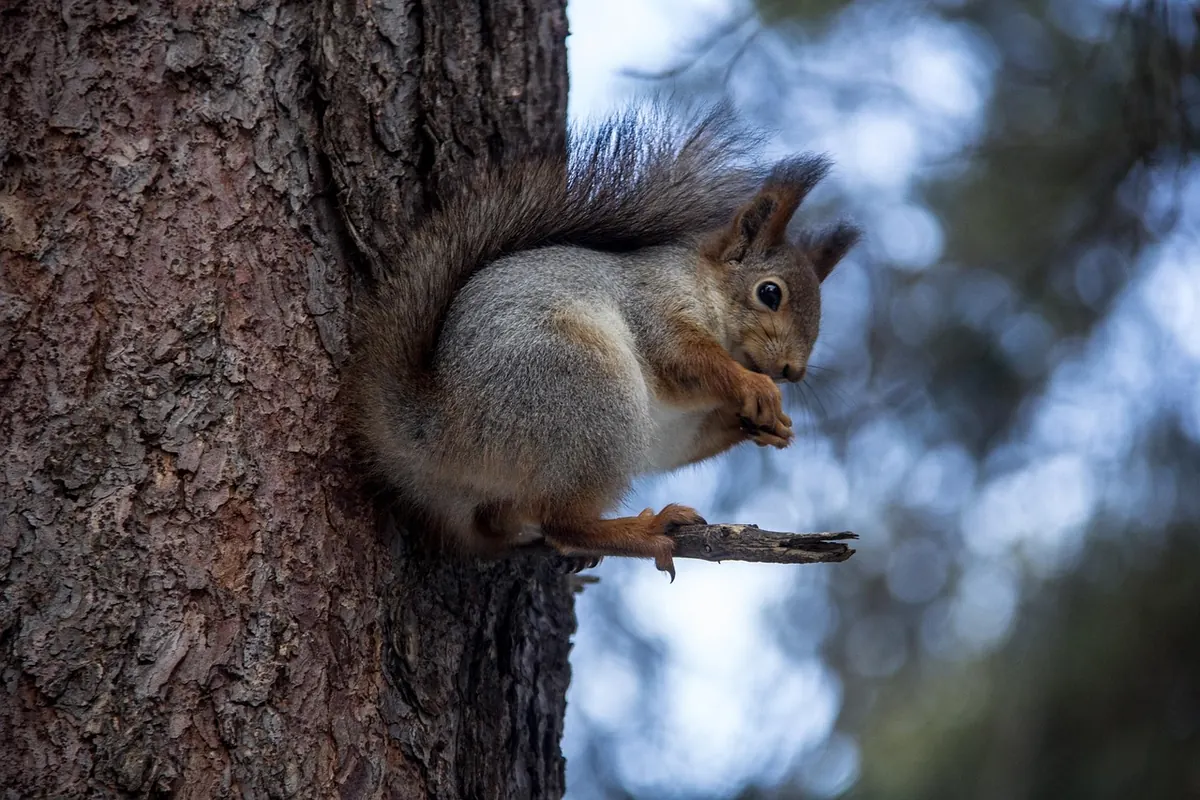
Red squirrels are the headline act, and conifer country is where they still do well. Grey squirrels have replaced them across most of England and Wales, but reds hold on where greys are scarce and pine cover is generous: the Scottish Highlands and southern Scotland, parts of Northumberland and Cumbria, Anglesey and the Isle of Wight among other pockets. Pine woods suit them because conifer seeds are a dependable crop through the year.
Look up and look for movement — a red squirrel moves in quick, jerky bursts along branches, then freezes. Check the ground beneath a favoured tree for pencil-thin cone cores, the stripped middens a squirrel leaves behind. Mid-morning is often the best window, once the frost has lifted and before the day quietens.
Pine martens are the harder prize. Cat-sized, chocolate brown with a pale bib and a long bushy tail, they are largely nocturnal and thinly spread. Numbers are recovering in Scotland, with reintroduction projects further south, and many sightings now come from trail cameras rather than eyes. If you walk forest tracks at dusk, keep quiet and watch for a low, bounding shape crossing open ground.
Crossbill, siskin and the canopy chorus
The crossbill is the bird that tells you where you are. Its bill tips cross over, letting it lever apart pine cone scales to reach the seeds, and it manages this at the very top of the canopy. Listen for a sharp chip chip overhead, then look for a chunky, brick-red bird (males) or a greenish one (females) silhouetted against the sky. Crossbills are unusual in nesting in late winter and early spring, timed to the cone crop.
Siskins are smaller and busier — streaky green-yellow finches that dangle upside down on cones and give a rising, wheezy call. They have taken to garden feeders in winter, so a pine wood in autumn can be oddly quiet while the birds are a mile away at someone's sunflower hearts.
Two more to know by ear: the coal tit, with its black cap and white nape patch, and the goldcrest, Britain's smallest bird, whose thin, high call is often the first sign of a mixed flock moving through the trees. If you hear a party of tits, stop and wait — the flock will pass you rather than the other way round.
Where to find the Caledonian specialists
Crested tits and capercaillie are birds of the old pinewoods. The crested tit is a Scottish speciality, found in Caledonian pine remnants such as Abernethy, Rothiemurchus, Glen Affric and Culbin. Look for a small, grey-brown bird with a spiky crest and a black-and-white patterned face, often travelling with coal tits.
Capercaillie are far rarer and in long-term decline. These are massive, dark grouse that lek in spring, males making a strange series of pops and clicks before dawn. They are highly sensitive to disturbance, so stick to marked paths in spring, keep dogs close and follow any site guidance. Do not play recordings to draw them in.
Nightjars after dusk
In lowland heaths with scattered pines and forestry clearings, summer evenings belong to the nightjar. Arriving from Africa in May, males give a sustained churring song from a favoured perch, and in flight show white patches on the wings and tail. The effect is mechanical, almost like a distant engine, and it stops the moment the bird turns its head.
The technique is simple: find a quiet edge between heath and pines, wait until the light has gone, and listen. Allow your eyes twenty minutes to adjust. August evenings are quieter than June ones, so go early in the season if you can.
Wood ants and the pine hoverfly
Wood ant nests are the landmarks of a pine wood — domed mounds of pine needles, resin and soil, sometimes a metre high and busy with thousands of workers. The Scottish wood ant is the classic species of northern pinewoods. The ants farm aphids in the trees above and defend the nest by spraying formic acid, so keep your face back and wash your hands afterwards. Never kick a mound open.
More obscure is the pine hoverfly, one of Britain's rarest insects and known from only a handful of Scottish sites. Its larvae develop in water-filled rot holes in old pine stumps — a reminder that the most valuable thing in a pine wood is often a dead tree left standing. If you are involved in woodland management, that is worth remembering.
Fungi beneath the pines
Autumn brings the fungi. The pine bolete appears from late summer, a heavy, dark-chestnut capped mushroom growing in association with pine roots, and the fly agaric — red with white spots — turns up under pines as readily as under birch.
Treat fungi as part of the wood rather than a harvest. If you are not experienced, leave them where they are and enjoy them in place. Never eat a fungus you cannot identify with certainty, and check the rules of the site you are on: picking is restricted in many nature reserves.
How to look well in pine woods
Almost everything here rewards patience more than equipment. A decent pair of binoculars and a willingness to stand still for ten minutes will get you further than a long walk at speed.
- Go early. Birds are most active in the first two or three hours after dawn.
- Look up. Crossbills, siskins and goldcrests feed high, often at the very top of the canopy.
- Read the ground. Nibbled cones, cone cores, droppings and digging give away what has been through before you.
- Learn three calls. Crossbill, siskin and goldcrest will do more for your hit rate than any gadget.
- Keep to paths in spring. Capercaillie and nightjar are easily disturbed at their most vulnerable time of year.
- Dress quietly. Muted colours and no strong scent make a real difference in woodland.
- Be careful with location sharing. Posts with precise grid references for scarce species can put them at risk.
Pine woods are slow places, and that is the point. Pick one stand you can return to through the year, learn its noises, and the ten species here will start finding you rather than the other way round.
Photo: Niko_Shogol / Pixabay