Stand at the edge of a mixed plantation and the conifers can blur into one dark green mass. Look closer and the differences stop being subtle. Conifers give you three reliable clues — how the needles attach, what the cones do, and how the bark breaks — and once you know what to check, most trees resolve in under a minute.
Silhouettes mislead. A young fir can look like a spruce; a clipped pine can look like nothing much at all. Twigs and cones are harder to argue with. Start with the needles, because almost everything else follows from there.
Pines: needles in bundles
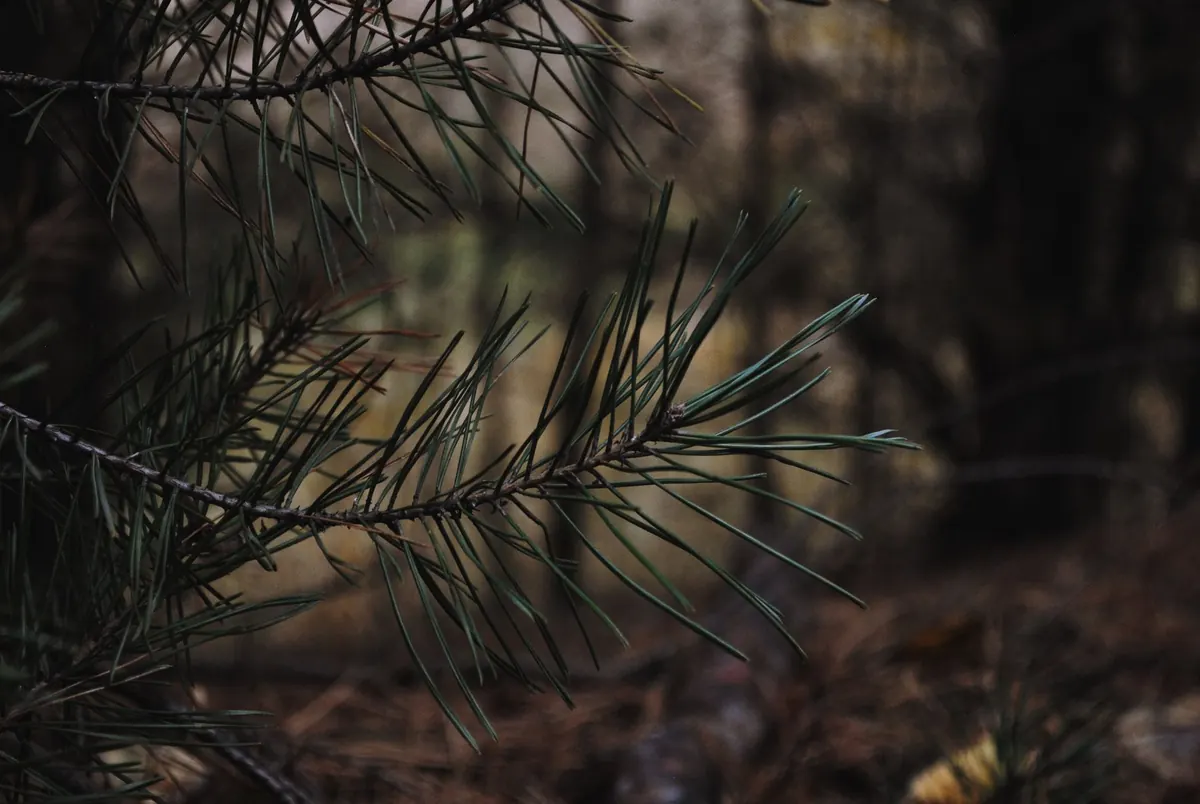
The quickest test in conifer identification is this: if the needles come away from the twig in bundles, you are looking at a pine. Each bundle is a fascicle, with a papery sheath at the base. Count the needles inside it. Two-needle pines include Scots pine and Corsican pine, the two you will meet most often in Britain. Five-needle pines — Weymouth pine, Macedonian pine, Bhutan pine — carry softer, longer needles in looser bundles.
Try it on a Scots pine: pinch one bundle and pull. It comes away as a unit, sheath and all. Nothing else you are likely to find in a UK park or woodland does that.
Single needles: roll one between finger and thumb
If needles attach one at a time, you have narrowed things to spruce, fir, Douglas fir, hemlock, larch, cedar or yew. The roll test sorts out most of them in a second. Roll a needle between finger and thumb. Spruce needles are four-sided, so they roll easily and feel as though they have corners. Fir needles are flat; they resist, or twist instead.
The peg test (spruce)
Pluck a needle from a spruce and a small woody peg stays behind on the twig. Run a thumb along an older shoot and it feels rough, like a coarse file. That texture is one of the best winter clues going, because it survives when there are no cones to be found.
The scar test (fir)
Pull a needle from a true fir and it leaves a neat round scar, and the twig stays smooth. Fir needles often lie in two flat ranks either side of the shoot, like teeth on a comb, and most have two pale bands on the underside. Crush a few: firs tend to smell clean and resinous, sometimes of orange peel. Douglas fir, which is not a true fir at all, has a sharper citrus-and-turpentine smell, flat needles and pointed buds.
Cones: where they sit and what they leave behind
Fir cones grow upright on top of the branch, like small candles, and they fall apart on the tree rather than dropping whole. The scales scatter and leave a bare spike behind. That is why you can search the ground under a big fir for half an hour and find nothing but loose scales — useful evidence in itself.
Spruce cones hang down and fall whole, so they turn up under the tree. Pine cones also hang or angle downwards, but they take two seasons to ripen, which means a mature pine will often carry green cones and ripe brown ones on the same branch. Douglas fir cones hang, and their bracts stick out beyond the scales — three points on each, often described as a mouse's tail and hind feet.
Look up first, then look down. A tree carrying upright cones is a fir. A tree with cones tumbling whole onto the path is very unlikely to be one.
Bark and outline
Bark is slower to learn because it changes with age. Scots pine is the exception: upper trunks and branches turn warm orange and flake in patches, sometimes from quite a young age, while older trees develop thick plates above a darker, fissured base. Young firs have smooth grey bark, often studded with resin blisters, and even mature firs tend to show long vertical ridges rather than tight plates. Spruce bark is thinner and scalier, reddish-brown on young wood.
Overall shape helps, but only as a hint. Many spruces hold a narrow spire with drooping branchlets. Firs tend to be broader and flatter-topped with age. Scots pine usually shows a clean length of trunk below a rounded crown.
The awkward ones: larch, cedar, hemlock and yew
Four conifers break the simple rules, so it is worth knowing them before you get caught out.
- Larch is deciduous. Needles grow in soft whorls on short shoots, turn gold in autumn and drop, leaving bare branches through winter. Small egg-shaped cones stay on the tree.
- Cedar, meaning the true cedars, holds needles in dense clusters on short shoots and carries barrel-shaped cones that stand upright and break apart on the tree, rather like a fir's.
- Hemlock has flat single needles with pale bands underneath, a tiny stalk at the base, and small cones hanging at the tips of shoots. Uncommon in most of Britain, but planted in gardens and on large estates.
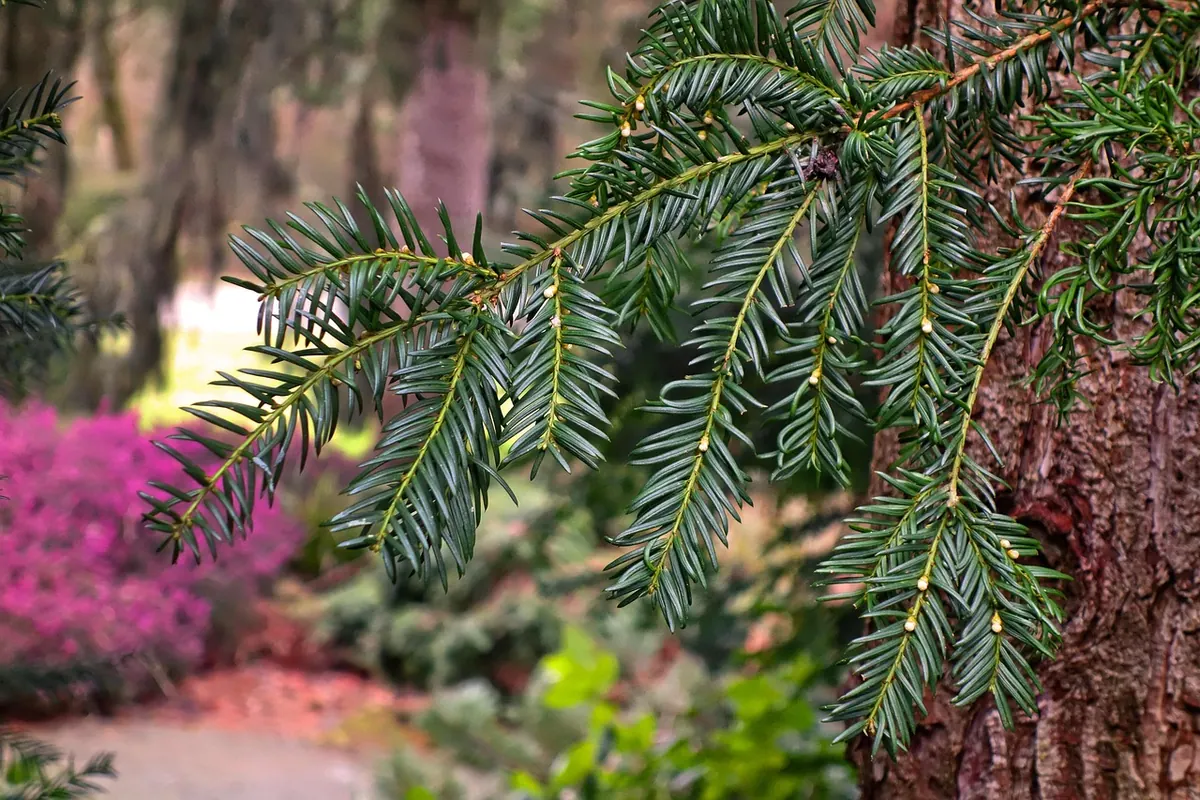
- Yew has flat single needles but no cones at all. Look for the red fleshy cup around a single seed in autumn. The needles are dark green above and dull beneath, with no white bands. Yew is toxic, so treat it as a tree to identify and admire rather than to taste.
A field routine that works
- Find a shoot you can reach and look at where the needles meet the wood.
- Bundles with a sheath at the base? Pine.
- Single needles? Roll one. If it rolls easily and feels cornered, think spruce — then check the twig for pegs.
- Flat and unwilling to roll? Turn it over. Two white bands and a smooth round scar point to fir or hemlock. Pale bands, a tiny stalk and a citrus smell point to Douglas fir.
- Check the tree for cones, then scan the ground beneath it. Whole woody cones suggest pine or spruce; loose scales and a central spike mean fir.
- Finally, step back and look at the bark and the shape of the crown. Use these to confirm, not to decide.
Practise on a tree you already know
Take one conifer you can name with certainty — a Scots pine
Photo: Candis Hidalgo / Pexels